Quantum Computing's Shockwave: The Race to Build a Universal Machine Intensifies, Reshaping Global Power Dynamics
The Unfolding Revolution: Why Quantum Computing Matters Now More Than Ever
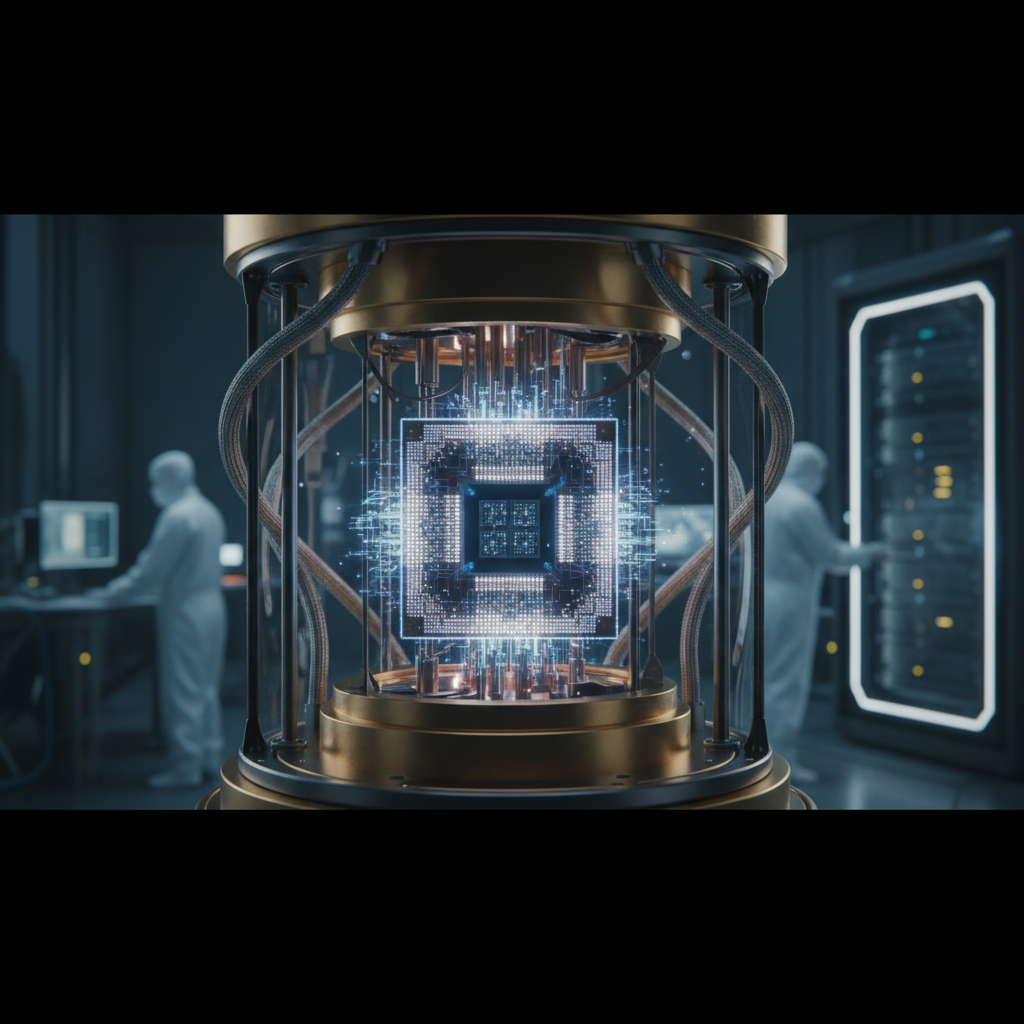
Imagine a computer capable of solving problems that would take even the most powerful supercomputers billions of years. This isn't science fiction; it's the promise of a universal quantum computer, and in mid-2026, the global pursuit to build such a machine has reached a fever pitch. This technological race isn't just about faster calculations; it's about fundamentally redefining industries from medicine to finance, ensuring national security, and ultimately, reshaping the geopolitical landscape. The breakthroughs emerging today are no longer incremental; they represent a potential paradigm shift, making the current moment a pivotal one in the history of technology.
The implications are staggering. A universal quantum computer could, in theory, break most modern encryption protocols, accelerate drug discovery at an unimaginable pace, revolutionize artificial intelligence, and optimize complex logistical challenges with unprecedented efficiency. Its development is not merely an engineering feat but a strategic imperative for nations and a competitive necessity for tech behemoths. Understanding this race, its players, and its potential impact is crucial for anyone looking to comprehend the future of our interconnected world.
The Long Road to Quantum: Background and Context
The concept of quantum computing dates back to the 1980s, with luminaries like Richard Feynman proposing the idea of using quantum mechanical phenomena to perform computations. Unlike classical computers that store information as bits (0 or 1), quantum computers use qubits, which can exist in a superposition of both 0 and 1 simultaneously. This, combined with phenomena like entanglement, allows quantum computers to process vast amounts of information in parallel, leading to exponential speedups for certain types of problems.
For decades, quantum computing remained largely theoretical or confined to rudimentary laboratory experiments. The early 2010s saw significant academic progress, but it wasn't until the late 2010s and early 2020s that major tech companies and national governments began investing heavily, recognizing its transformative potential. Companies like IBM, Google, Microsoft, and numerous startups, alongside national initiatives in the US, China, Europe, and Japan, have been pouring billions into research and development.
Initial breakthroughs focused on achieving 'quantum supremacy' or 'quantum advantage' – demonstrating that a quantum computer could perform a specific task beyond the capability of the best classical supercomputers. While impressive, these early machines were narrow in scope, often designed for one specific problem. The current race, however, is firmly focused on building a universal quantum computer – one that can be programmed to solve a wide array of complex problems across various domains.
Latest Developments: The Qubit Wars and Error Correction Breakthroughs
As of May 2026, the quantum computing landscape is characterized by intense competition and rapid innovation. Recent developments highlight two critical areas: increasing the number of stable, high-fidelity qubits, and making significant strides in fault-tolerant quantum computing through error correction.
IBM, a leading player, recently announced its roadmap aiming for a 2,000+ qubit machine by year-end, building on its 'Condor' processor. Their focus is not just on raw qubit count but on improving qubit coherence times and connectivity. Google, meanwhile, continues to push its superconducting qubit architecture, hinting at upcoming demonstrations of significantly enhanced error-corrected logical qubits.
Crucially, breakthroughs in error correction are gaining prominence. The inherent fragility of qubits – their susceptibility to noise and decoherence – has been a major hurdle. However, new research from institutions like QuTech in the Netherlands, published in Nature just last month, showcased novel techniques for encoding quantum information redundantly across multiple physical qubits to create more stable 'logical qubits'. This is a monumental step towards fault tolerance, which is essential for a universal quantum computer.
Another significant trend is the rise of alternative qubit technologies. While superconducting qubits currently dominate, companies and research groups are making advanced progress with trapped ions (IonQ, Quantinuum), photonic qubits (PsiQuantum), and topological qubits (Microsoft's long-term bet). The diversity of approaches suggests that the winning architecture for a universal machine is far from settled, fueling a vibrant, competitive ecosystem. Geopolitically, reports from the US Department of Defense indicate increasing concerns over China's accelerated progress in quantum communication networks, which are viewed as a precursor to advanced quantum computing capabilities. (Reuters report on China's quantum progress).
Key Facts & Data: The Numbers Behind the Quantum Leap
- Investment Surge: Global investment in quantum technologies (private and public) is projected to exceed $40 billion by 2027, with a significant portion directed towards hardware development. (Source: BCC Research - Quantum Market)
- Qubit Count: While today's machines range from dozens to a few hundred physical qubits, the consensus among experts is that thousands to hundreds of thousands of stable, error-corrected physical qubits will be needed for a truly universal quantum computer capable of widespread impact.
- Error Rates: Current physical qubit error rates are typically around 0.1% to 1%. For fault-tolerant computation, these rates need to be reduced significantly, potentially by several orders of magnitude, or highly efficient error correction schemes must compensate.
- Post-Quantum Cryptography (PQC): Governments and industries are actively developing and standardizing PQC algorithms to safeguard against future quantum attacks. NIST (National Institute of Standards and Technology) has several candidates under review, with final standardization expected in the coming years (NIST Post-Quantum Cryptography Portal).
- Talent Gap: A persistent challenge is the acute shortage of quantum physicists, engineers, and software developers. Universities and companies are ramping up educational programs, but the demand far outstrips supply.
Expert Insights: Beyond the Hype
Dr. Anya Sharma, a leading quantum physicist at MIT, notes, "We're seeing an inflection point. The engineering challenges are still immense, but the theoretical foundations for fault-tolerant quantum computing are solidifying. The next 3-5 years will be critical in determining which architectures scale most effectively towards a universal machine. It's not just about more qubits; it's about better qubits and robust error correction." McCormack, a cybersecurity expert, recently stated, "The race for a universal quantum computer isn't just about technological superiority; it's a new front in intelligence and national security. Who gets there first has unimaginable strategic advantages, particularly in areas like cryptography and advanced materials science."
From a national policy perspective, Dr. Lena Hansen, a senior analyst at the Atlantic Council, emphasizes, "The country that first achieves a truly universal quantum computer will possess an unparalleled strategic asset. This isn't just about economic advantage through superior R&D; it’s about a fundamental shift in scientific discovery capabilities, potentially leading to breakthroughs in energy, climate modeling, and defense that are currently beyond our reach." She adds, "This necessitates international cooperation on certain standards while intensifying competition on core technological development."
Real-World Impact: Reshaping Industries and Society
The advent of a universal quantum computer will usher in profound transformations across various sectors:
- Cybersecurity: The most immediate and widely discussed impact is on encryption. Many of the cryptographic algorithms that secure our internet, financial transactions, and classified communications are vulnerable to Shor's algorithm, which a sufficiently powerful quantum computer could execute. This threat drives the urgent development and deployment of post-quantum cryptography.
- Drug Discovery and Materials Science: Quantum computers can simulate molecular interactions with unprecedented accuracy, accelerating the design of new drugs, personalized medicines, and advanced materials (e.g., superconductors, catalysts, batteries) that are currently too complex for classical computers to model efficiently.
- Artificial Intelligence and Machine Learning: Quantum algorithms could enhance AI capabilities by speeding up training for complex neural networks, optimizing machine learning models, and enabling new forms of AI that leverage quantum phenomena directly, leading to more powerful and efficient AI systems.
- Finance and Optimization: Quantum optimization algorithms could revolutionize financial modeling, portfolio management, fraud detection, and complex logistical challenges for supply chains, transportation networks, and even traffic management, leading to enormous efficiencies and cost savings.
- Climate Change and Energy: Simulating complex climate models, optimizing energy grids, and designing more efficient renewable energy sources are other areas where quantum computing could provide critically needed breakthroughs.
However, the potential for misuse also looms. The same power that can accelerate medical breakthroughs could also be weaponized. Ethical guidelines, international treaties, and robust regulatory frameworks will be vital to ensure that quantum computing's transformative power benefits humanity responsibly.
Conclusion: On the Brink of a Quantum العمر
The year 2026 marks a watershed moment in the quantum computing journey. The race to build a universal quantum machine is no longer a distant vision but an intense, highly competitive endeavor shaping global technological supremacy. With significant strides in qubit stability, error correction, and diverse architectural approaches, the scientific community and major tech players are on the cusp of an unprecedented technological revolution. The impacts, both positive and challenging, will reverberate across every facet of society, from economic competitiveness and national security to scientific discovery and ethical considerations. The coming years will undeniably determine the trajectory of this game-changing technology and the new world it promises to unlock.
Future Outlook
The next five years are expected to bring even more rapid advancements. We anticipate the emergence of more stable, medium-scale quantum devices that can tackle specific industry-relevant problems, even before a fully universal, fault-tolerant machine is realized. The focus will likely shift from purely demonstrating quantum advantage to achieving 'quantum utility' – where quantum computers offer a demonstrable, practical benefit over classical solutions for real-world applications. This will necessitate closer collaboration between quantum hardware developers, software engineers, and domain experts to bridge the gap between theoretical potential and practical implementation. The geopolitical ramifications will also intensify, demanding carefully crafted international policies to manage both collaboration and competition in this critical technological domain.