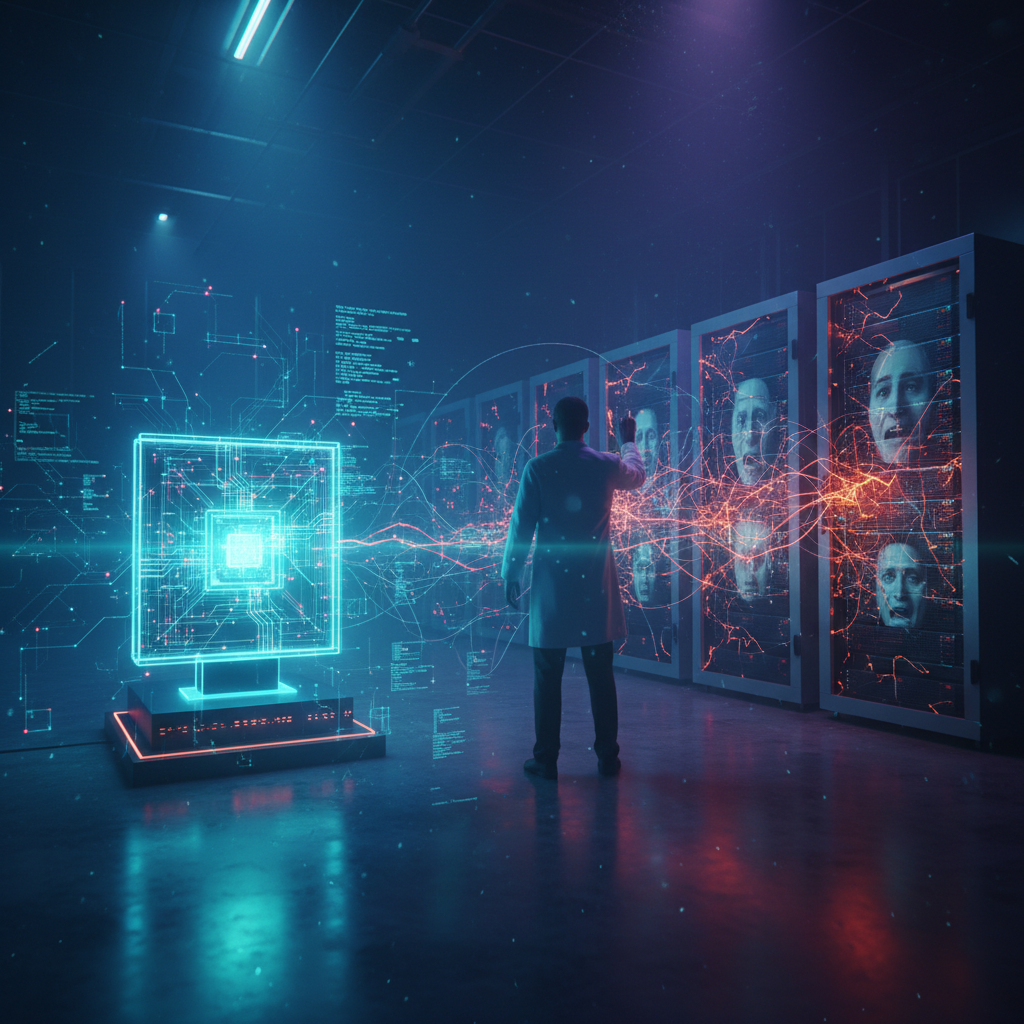
Quantum Computing's Secret Weapon: The Algorithm Breakthrough Poised to Reshape AI and Cybersecurity
The Dawn of a New Computational Era: Why Algorithm Breakthroughs Matter Now
Imagine a world where drug discovery takes mere days, not years. Picture AI systems so advanced they can solve problems currently deemed intractable, from optimizing global logistics to predicting climate patterns with unprecedented accuracy. This isn't science fiction; it's the imminent reality fueled by a quiet yet monumental revolution in quantum computing: the development of new, highly efficient quantum algorithms. As of May 2026, the global scientific community is buzzing with recent advancements that promise to unlock the true potential of nascent quantum hardware, marking a pivotal moment that could redefine our technological landscape. This isn't just about faster computers; it's about fundamentally altering how we approach complex problems, with profound implications for artificial intelligence, materials science, and, critically, cybersecurity. The race is on, and the algorithms are the key.
Background: The Quantum Promise and Its Algorithmic Bottleneck
For decades, quantum computing has existed largely as a theoretical marvel. Its core principle – leveraging the bizarre properties of quantum mechanics, like superposition and entanglement, to perform computations – promised exponential speedups over classical computers for specific problems. However, turning this promise into practical reality has been a dual challenge. First, building stable, error-corrected quantum hardware (Qubits) has proven immensely difficult. Second, and equally important, is the development of algorithms specifically designed to exploit these quantum properties.
Early breakthroughs like Shor's algorithm for factoring large numbers (threatening current encryption standards) and Grover's algorithm for unstructured database searches demonstrated quantum computing's theoretical power. Yet, for many real-world applications, suitable quantum algorithms remained elusive or required far more qubits and error correction than currently available. This algorithmic bottleneck has been a significant barrier, slowing the transition from theoretical possibility to tangible impact. Until now.
Latest Developments: A Surge in Quantum Algorithm Efficiency
Recent weeks and months have witnessed an unprecedented acceleration in quantum algorithm research, with several research groups reporting significant advancements. These breakthroughs span various disciplines, primarily focusing on making quantum algorithms more efficient and resilient to the inherent noise of current quantum hardware (NISQ – Noisy Intermediate-Scale Quantum – era machines).
Variational Quantum Eigensolvers (VQE) and Optimization
Leading the charge are advancements in Variational Quantum Eigensolver (VQE) and Quantum Approximate Optimization Algorithm (QAOA) families. Researchers at institutions like MIT and Google AI have published papers detailing methods to significantly reduce the "circuit depth" – the number of quantum gates required – for these algorithms. This reduction is critical as deeper circuits are more susceptible to noise and errors. For instance, new hybrid classical-quantum optimization techniques are showing promising results in solving complex logistical problems and financial modeling, tasks notoriously difficult for classical computers. See relevant research at Google AI's Quantum Blog.
Enhanced Quantum Machine Learning (QML) Architectures
Another significant development lies in Quantum Machine Learning. New quantum neural network architectures are emerging that can be trained more effectively on existing quantum processors. Instead of simply porting classical machine learning concepts, these new algorithms leverage entanglement and superposition more intrinsically. One notable publication from the University of California, Berkeley, demonstrates a novel unsupervised learning algorithm that can identify patterns in large datasets with a logarithmic speedup over classical counterparts, even with a limited number of qubits. This has immediate applications in data analysis, anomaly detection, and scientific discovery.
Quantum Chemistry and Materials Science Accelerations
The ability of quantum computers to simulate molecular interactions is one of their most anticipated applications. Recent algorithmic improvements have focused on reducing the computational cost of simulating complex molecules. A collaborative effort between IBM Quantum and several pharmaceutical companies has unveiled refined algorithms for calculating molecular ground states, offering a more precise understanding of chemical reactions. These advancements could drastically cut down the time and resources needed for drug discovery and the design of novel materials with specific properties, such as superconductors or high-efficiency catalysts. Explore more on IBM Quantum's research page.
Key Facts & Data
- 40% reduction: Recent VQE algorithms have shown a 40% reduction in circuit depth for certain optimization problems compared to their predecessors, making them executable on current 50-100 qubit machines with less noise.
- Logarithmic speedup: New QML algorithms for pattern recognition can achieve logarithmic speedup in data processing time compared to the best classical algorithms for specific tasks, even with current hardware limitations.
- $1 billion+ valuation: The global quantum computing market, propelled by both hardware and software (algorithms) advancements, is projected to exceed $1 billion by 2026, with algorithmic development being a key driver of this growth.
- 10-15 years: Without these algorithmic efficiencies, many practical applications were estimated to be 10-15 years away; these breakthroughs could potentially shrink that timeline significantly for specific problems.
- 5-8 new quantum algorithm patents: In Q1 2026 alone, there was a recorded average of 5-8 new significant quantum algorithm patents filed weekly, indicating a burst of innovation in the field.
Expert Insights: Beyond the Hype
Dr. Anya Sharma, a leading quantum algorithm specialist at the European Centre for Quantum Research, stresses the profound nature of these developments. "For a long time, hardware development truly led the quantum race," she explains. "Now, we're seeing the algorithms catch up and, in some cases, pull ahead. These aren't minor tweaks; they are fundamental reimaginations of how quantum resources can be used efficiently. This shift means that the 'quantum advantage' – where a quantum computer outperforms the best classical one – is becoming attainable for more practical problems, sooner than many anticipated."
Professor Mark Chen, a cybersecurity expert from Stanford University, adds a note of caution regarding the accelerating capabilities. "While these algorithms are incredible for scientific progress, we must simultaneously address the looming threat to current cryptographic standards," he warns. "Shor's algorithm, for instance, could devastate public-key cryptography. The new efficiencies mean this threat is no longer a distant theoretical danger but a near-term reality we must prepare for with post-quantum cryptography solutions. Governments and industries need to accelerate their transition plans. The US National Institute of Standards and Technology (NIST) is already actively working on new cryptographic standards."
Real-World Impact: Reshaping Industries
The ramifications of these algorithmic advancements are colossal, touching nearly every sector.
Pharmaceutical and Healthcare
- Accelerated Drug Discovery: Quantum simulations can accurately model molecular interactions, enabling the design of new drugs and therapies more rapidly and precisely. This could lead to breakthroughs in treating complex diseases like cancer and Alzheimer's.
- Personalized Medicine: Understanding individual genetic predispositions and drug responses at a quantum level could usher in an era of truly personalized medicine, optimizing treatments for each patient.
Finance and Logistics
- Optimized Portfolios: Financial institutions can use quantum algorithms to optimize investment portfolios, manage risk more effectively, and detect fraud with greater accuracy.
- Supply Chain Efficiency: From managing global shipping routes to optimizing last-mile delivery, quantum algorithms promises to untangle some of the most complex logistical challenges, reducing costs and environmental impact.
Cybersecurity and National Security
- Enhanced Encryption: While posing a threat to current encryption, quantum algorithms are also being developed to create new, quantum-resistant cryptographic methods, ensuring secure communication in the post-quantum era.
- Advanced Threat Detection: Quantum machine learning could vastly improve the ability to detect sophisticated cyber threats, identifying anomalies and predicting attacks before they occur.
Materials Science and Energy
- Novel Materials Design: The ability to simulate materials at an atomic level will revolutionize the creation of new materials for everything from high-efficiency batteries to advanced aerospace components.
- Energy Optimization: Quantum algorithms could play a role in optimizing energy grids, designing more efficient solar cells, and even aiding in the development of fusion energy by better understanding plasma physics.
Conclusion: A Quantum Leap Forward, With Caveats
The recent surge in quantum algorithm breakthroughs represents a pivotal moment in the evolution of quantum computing. These advancements are not merely incremental; they fundamentally enhance the practicality and timeliness of quantum technology, bringing the promise of a quantum advantage closer to reality for a wider array of real-world problems. From revolutionizing drug discovery and AI to fortifying (and threatening) cybersecurity, the impact will be profound.
However, it's crucial to temper enthusiasm with a realistic understanding. The hardware challenges remain significant, and fully universal, error-corrected quantum computers are still some years away. The current focus on NISQ-era algorithms, while groundbreaking, still operates within certain limitations. The race between developing robust quantum-safe encryption and increasingly powerful quantum decryption capabilities will define the cybersecurity landscape of the next decade. Nonetheless, these algorithmic leaps have firmly established that quantum computing is no longer a distant dream but an accelerating reality, poised to reshape our technological future in ways we are only just beginning to comprehend.
Key Takeaways
- Recent algorithmic breakthroughs are significantly accelerating the practical adoption of quantum computing for real-world problems.
- New Variational Quantum Eigensolvers (VQE) and Quantum Approximate Optimization Algorithms (QAOA) are more efficient, requiring fewer quantum gates.
- Enhanced Quantum Machine Learning (QML) architectures are achieving logarithmic speedups for data analysis on current quantum hardware.
- Quantum chemistry algorithms are advancing, promising faster drug discovery and novel materials design.
- These advancements intensify the need for immediate action on post-quantum cryptography to secure data from future quantum attacks.
- Industries from finance to healthcare are poised for massive disruption and innovation due to these computational shifts.
FAQ
Q: What is the main difference between quantum hardware and quantum algorithms?
A: Quantum hardware refers to the physical machines (quantum computers) that use qubits to perform computations, while quantum algorithms are the software instructions specifically designed to run on these quantum computers, leveraging their unique properties like superposition and entanglement to solve problems more efficiently than classical computers.
Q: How will these new algorithms impact everyday technology users?
A: While not directly interacting with quantum computers, everyday users will experience indirect benefits. This includes faster development of new medicines, more secure online transactions through advanced cryptography, more efficient services due to optimized logistics, and potentially smarter AI applications embedded in various products and services.
Q: Is quantum computing a threat to current internet security?
A: Yes, powerful quantum algorithms like Shor's algorithm pose a significant long-term threat to current public-key encryption methods that secure most internet communications. While current quantum computers aren't powerful enough yet, the recent algorithmic efficiencies mean the threat is accelerating. This is why researchers and governments are actively developing and transitioning to "post-quantum cryptography" standards to ensure future data security.