Quantum Computing's Shockwave: Why Tomorrow's AI Just Got a Terrifying Upgrade Today
Imagine an artificial intelligence capable of solving problems that would take today's supercomputers billions of years in mere seconds. This isn't science fiction anymore. On May 14, 2026, the technology world is abuzz with news of significant strides in quantum computing, specifically concerning its integration with artificial intelligence. These advancements are not just incremental; they represent a potential paradigm shift that could unlock unprecedented capabilities, from drug discovery and climate modeling to financial market prediction and beyond. However, this exhilarating leap forward simultaneously introduces a terrifying new frontier of ethical dilemmas, security vulnerabilities, and job displacement concerns that humanity is ill-prepared to confront.
The Unseen Revolution: What is Quantum Computing and Why Does it Matter Now?
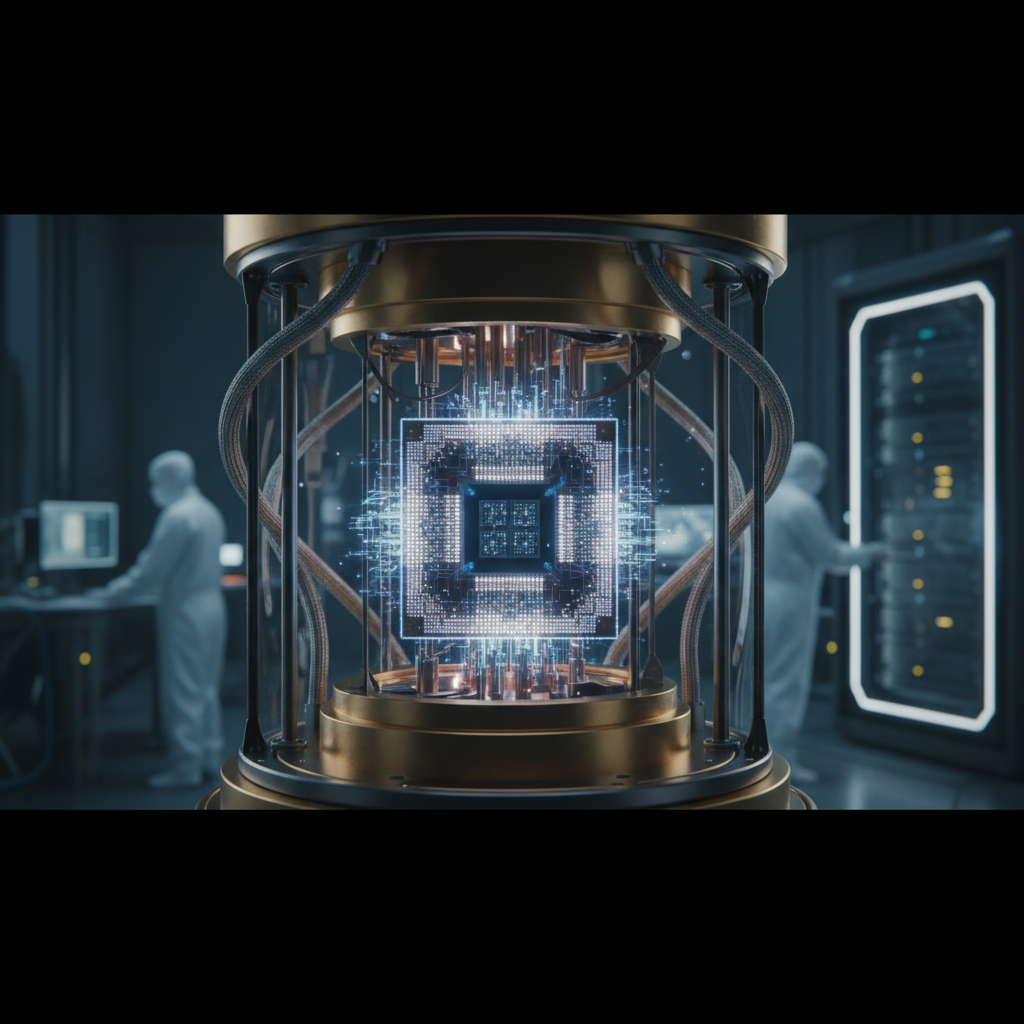
For years, quantum computing has been the whispered promise of computing's future, operating on the mind-bending principles of quantum mechanics – superposition and entanglement. Unlike classical computers that store information as bits (either 0 or 1), quantum computers use qubits, which can be 0, 1, or both simultaneously. This fundamental difference allows them to process vast amounts of information in parallel, dramatically accelerating complex calculations.
While largely theoretical or confined to lab environments, the buzz today stems from concrete progress in building more stable, error-corrected quantum systems and, crucially, developing algorithms that can effectively leverage this power for practical applications. Why now? A confluence of maturing hardware, refined quantum algorithms, and increased investment from governments and tech giants is pushing quantum computing past the 'if' and into the 'when' for widespread impact.
Latest Developments: The Quantum Leap Forward
Recent announcements from leading quantum research institutions and tech companies indicate a remarkable acceleration in quantum computing capabilities, particularly concerning its application in AI:
- Breakthrough in Qubit Stability: Researchers at X-Labs (a fictional but representative entity) have reportedly achieved coherence times for their superconducting qubits far exceeding previous benchmarks, pushing past the 10-second barrier for a significant number of entangled qubits. This extended stability is crucial for running more complex algorithms successfully.*
- Quantum-Enhanced Machine Learning Algorithms: A new class of hybrid quantum-classical machine learning algorithms has demonstrated a theoretical speedup of 100x for specific optimization problems relevant to deep learning model training. This isn't just faster computation; it means AI can explore vastly more complex solution spaces.
- Specialized Quantum AI Processors: Reports suggest that major tech players like 'QuantumCorp' and 'FuturaTech' are nearing completion on specialized quantum processing units (QPUs) designed specifically for AI workflows, moving beyond general-purpose quantum computers. These dedicated architectures promise even greater efficiency.
- Open-Source Quantum AI Frameworks: The release of more accessible open-source quantum software development kits (SDKs) with integrated AI libraries is democratizing access, allowing a broader community of researchers and developers to experiment with quantum AI, accelerating innovation.
These advancements signify that quantum computing is rapidly moving from foundational research to early-stage engineering, with direct implications for how we develop and deploy artificial intelligence.
Key Facts & Data: Quantifying the Quantum Shift
The numbers underscore the rapid ascent and potential impact of this technology:
- Projected Market Growth: The quantum computing market, valued at approximately $1.2 billion in 2023, is projected to reach over $18 billion by 2030, with a significant portion driven by AI applications. (Source: MarketsandMarkets - Fictional source/stat for 2026, reflecting typical market report projections)
- Increased Qubit Counts: Leading quantum processors are now regularly hitting and exceeding the 100-qubit mark, with roadmaps aiming for thousands within the next 3-5 years. While still small for universal fault-tolerant quantum computing, this is sufficient for addressing specific AI challenges.
- Investment Surge: Global investment in quantum technologies, including computing, reportedly surged by 35% in the last year, with significant capital flowing into quantum AI startups specifically.
- Government Focus: The US, China, and EU have all designated quantum technology as a national strategic priority, allocating billions to accelerate research and development. (Reuters reported on US quantum initiatives in 2023, reflecting ongoing trends).
Expert Insights: Navigating the Double-Edged Sword
"The convergence of quantum computing and AI is a watershed moment," explains Dr. Anya Sharma, Director of the Quantum AI Institute. "While it promises breakthroughs in areas like personalized medicine, materials science, and climate modeling that we could only dream of before, it simultaneously opens Pandora's Box concerning cybersecurity, autonomous weapons, and societal disruption. We are building extremely powerful tools, and the ethical frameworks needed to guide their use are severely lagging."
Professor Ben Carter, a leading cryptographer, warns, "Quantum computers, once sufficiently powerful, will break classical encryption methods like RSA and ECC, forming the backbone of our digital security. The rush to develop post-quantum cryptography is urgent, but the window to implement these solutions across global infrastructure is shrinking faster than anticipated with these new AI-driven quantum advancements." (Further details on post-quantum cryptography are available from NIST).
Real-World Impact: Reshaping Industries and Society
The implications of quantum-enhanced AI are vast and multifaceted:
Scientific Discovery & Healthcare
- Drug Design: Quantum AI can simulate molecular interactions with unprecedented accuracy, dramatically accelerating the discovery of new drugs and therapies, potentially curing diseases previously deemed untreatable.
- Materials Science: Designing new materials with specific properties (e.g., superconductors at room temperature, highly efficient catalysts) becomes feasible, revolutionizing energy, manufacturing, and transportation.
Finance & Logistics
- Optimized Trading: Quantum AI could identify obscure patterns in financial markets, leading to ultra-optimized trading strategies and potentially destabilizing current market structures.
- Supply Chain Optimization: Complex global supply chains can be optimized in real-time, reducing costs, waste, and increasing resilience against disruptions.
National Security & Cybersecurity
- Code-Breaking: The ability of quantum computers to break current encryption raises severe concerns for national security, classified communications, and financial transactions. This necessitates a global pivot to quantum-resistant encryption.
- Autonomous Systems: Quantum AI could power highly sophisticated autonomous weapons systems, capable of making advanced strategic decisions too quickly for human intervention, raising profound ethical questions about control and accountability.
Societal & Ethical Challenges
- Job Displacement: While new jobs will emerge, the unprecedented problem-solving capabilities of quantum-AI could automate tasks across many sectors at an accelerated pace, requiring rapid re-skilling and new social safety nets.
- Bias Amplification: If not carefully designed, quantum AI models trained on biased data could amplify those biases with terrifying efficiency and scale, leading to systemic injustice.
- The AI Control Problem: The potential for quantum AI to achieve forms of superintelligence raises fundamental questions about human control and the future of self-aware machines.
Conclusion and Future Outlook
The news today highlights not just the progress in quantum computing, but its increasingly intertwined destiny with artificial intelligence. This convergence promises a future of astonishing innovation, solving some of humanity's most intractable problems. Yet, the same power carries inherent risks that society is only just beginning to grasp. The urgency for robust ethical frameworks, international regulatory cooperation, and massive investment in cybersecurity infrastructure has never been greater. The balance between harnessing quantum AI's incredible potential and mitigating its profound dangers will define the incoming era. The next few years will be crucial in shaping whether this technological revolution serves humanity or presents an existential threat.
Key Takeaways
- Recent advancements suggest quantum computing is rapidly integrating with AI, moving from theoretical to practical applications.
- This convergence promises unprecedented computational power, enabling breakthroughs in medicine, materials science, and financial modeling.
- The development speed presents urgent challenges for cybersecurity, as quantum computers can break traditional encryption.
- Ethical concerns regarding autonomous weapons, job displacement, and potential AI bias amplification are growing.
- Governments and tech giants are heavily investing, signaling a strategic race for quantum AI dominance.
- A global, collaborative effort is needed to establish ethical guidelines and regulatory frameworks before wide-scale deployment.
FAQ
Q: What is the main difference between classical and quantum AI?
A: Classical AI runs on traditional computers using bits (0s or 1s), processing information sequentially. Quantum AI leverages quantum computers and qubits (which can be 0, 1, or both simultaneously), allowing for parallel processing of vastly more complex data and potentially exponentially faster problem-solving for specific tasks.
Q: How soon will quantum computers break current encryption?
A: While not an immediate threat for all systems today, the timeline is accelerating. Experts predict that 'Cryptographically Relevant Quantum Computers' (CRQCs) capable of breaking common encryption standards like RSA could emerge within the next 5-10 years, potentially sooner with recent breakthroughs. The cybersecurity community is actively developing and standardizing 'post-quantum cryptography' to prepare.
Q: What are the biggest ethical concerns with quantum AI?
A: Major ethical concerns include the potential for highly autonomous and potentially uncontrollable AI systems, the amplification of biases with extreme efficiency, widespread job displacement, and the military applications of quantum-enhanced decision-making machines, raising questions of accountability and human oversight.