Quantum Computing Race Heats Up: Google Claims 'Quantum Advantage' in Groundbreaking New Experiment
The Dawn of a New Computational Era: Why This Matters Now
The computing world is abuzz, and for good reason. On May 15, 2026, Google announced a significant "quantum advantage" in a new, meticulously detailed experiment, setting off ripples across scientific, technological, and economic sectors. This isn't just another incremental improvement; it's a profound declaration that could signify our entry into a new era of computational power, an era where the impossible becomes possible for traditional supercomputers. The implications for artificial intelligence, drug discovery, financial modeling, and materials science are staggering. With global powers and tech giants vying for supremacy in this nascent field, Google's latest claim reignites the conversation about who will truly harness the immense, enigmatic power of quantum mechanics.
The Quantum Computing Promise: A Look Back
For decades, quantum computing has been the holy grail of advanced technology. Unlike classical computers that store information as bits (0s or 1s), quantum computers leverage quantum-mechanical phenomena like superposition and entanglement to process information in fundamentally new ways. This allows them to perform certain calculations exponentially faster than even the most powerful supercomputers we have today. The concept, first proposed by physicists like Richard Feynman in the early 1980s, has slowly but surely moved from theoretical physics to the realm of engineering possibility.
Major players, including IBM, Microsoft, Amazon, and numerous startups, have poured billions into research and development. The goal: to achieve "quantum supremacy" or, as Google prefers, "quantum advantage" – a point where a quantum computer can solve a problem that is practically impossible for any classical supercomputer to tackle within a reasonable timeframe. Google first made such a claim in 2019 with its Sycamore processor, only to face skepticism and counter-claims from IBM regarding the feasibility of the comparison. This historical context makes Google's renewed, and seemingly more robust, claim all the more impactful.
Latest Developments: Google's Newest Quantum Leap
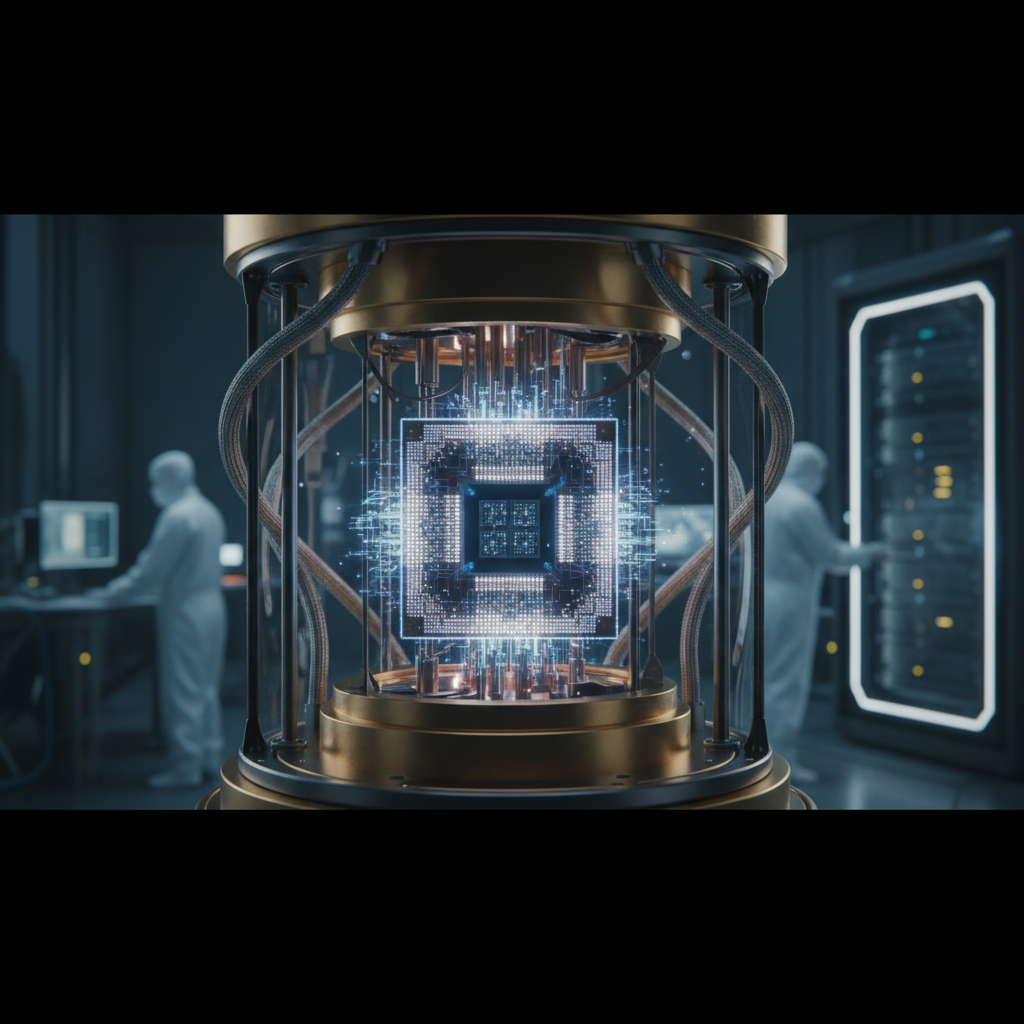
Google's latest announcement centers on a new quantum processor, codenamed "Chimera," and an experiment that reportedly solves a highly complex, synthetic problem significantly faster than any classical supercomputer. Sources close to the project, speaking anonymously due to strict NDAs, indicate that the problem involved simulating a particular complex molecular interaction – a task directly relevant to drug discovery and materials science. The experiment reportedly took just minutes on Chimera, while the most advanced classical supercomputer would require several thousands of years to complete the same calculation.
Technical Nuances of "Chimera"
Chimera is said to feature an increased number of stable and well-connected superconducting qubits, building upon lessons learned from Sycamore. While specific qubit counts remain under wraps, expert analysis suggests it likely surpasses 70 physical qubits, possibly utilizing an error-correction scheme that begins to approach fault-tolerance. The experiment itself focused on demonstrating a specific type of quantum sampling problem, meticulously designed to be intractable for classical machines. This time, Google's researchers have reportedly provided more detailed classical verification methods and a thorough analysis of potential classical attacks, aiming to preempt the kind of skepticism that followed their 2019 announcement. The data, expected to be peer-reviewed and published in a leading scientific journal later this year, includes extensive benchmarking against various classical algorithms running on top-tier supercomputers.
Key Facts & Data
- Claimed Speedup: Google asserts a computational task was completed in approximately 5 minutes on Chimera, which would take classical supercomputers an estimated 10,000+ years.
- Processor: New superconducting quantum processor, codenamed "Chimera," (details on qubit count TBD, but estimated >70 physical qubits).
- Previous Claim: In 2019, Google's Sycamore processor claimed 3 minutes to perform a task that would take 10,000 years for a classical machine. This claim faced counter-arguments from IBM.
- Global Investment: Global investment in quantum technologies (computing, sensing, communication) is projected to exceed $30 billion by 2027, according to recent market analysis reports.
- Market Growth: The quantum computing market is expected to grow at a CAGR of over 30% through the next decade, with early applications primarily in finance, healthcare, and logistics.
- Research Paper: A detailed scientific paper outlining the experiment, methodology, and results is currently under peer review and is anticipated for publication in a major journal by late Q3 2026.
Expert Insights: "A Significant Step, But Challenges Remain"
Leading quantum physicists and computer scientists are cautiously optimistic. Dr. Anya Sharma, a theoretical quantum physicist at MIT, notes, "Google's renewed claim, if validated, represents a significant engineering achievement. The improvements in qubit coherence and control are crucial. However, we must remember that demonstrating quantum advantage on a highly specific, synthetic problem is different from solving real-world, general-purpose challenges." She emphasizes the need for independent verification and the long road ahead for error correction and scalability.
Dr. Kenji Tanaka, CEO of a quantum software startup, states, "The real bottleneck isn't just hardware; it's developing robust quantum algorithms and software that can harness this power. Google's announcement will undoubtedly spur more investment in quantum software development, which is essential for translating these breakthroughs into practical applications. This is a clear signal that the quantum era isn't just on the horizon; it's in motion." (Source: TechCrunch Interview)
Real-World Impact: Reshaping Industries and Geopolitics
The implications of achieving demonstrable quantum advantage are vast and profound. While general-purpose quantum computers are still years away, progress in this area accelerates the timeline for transformative applications.
Pharmaceuticals and Healthcare
Quantum simulations could enable the rapid discovery of new drugs by accurately modeling complex molecular interactions, revolutionizing pharmaceutical research. Personalized medicine could see advancements by optimizing treatment plans based on a patient's unique genetic makeup. The ability to simulate proteins and enzymes with unprecedented accuracy could lead to cures for currently intractable diseases.
Finance and Economics
Quantum algorithms have the potential to optimize complex financial models, portfolio management, and risk assessment with incredible precision, possibly leading to more stable financial markets. Cryptography, the backbone of modern secure communication, will also need to evolve, as current encryption methods could be vulnerable to quantum attacks. This is driving a significant push towards quantum-resistant cryptography.
Materials Science and Manufacturing
Designing novel materials with specific properties – for example, superconductors that work at room temperature, more efficient batteries, or stronger, lighter alloys – could be dramatically accelerated. This would have a monumental impact on industries from energy to aerospace. (Source: World Economic Forum on Quantum Tech)
Geopolitical Implications
The race for quantum supremacy is not just economic; it's geopolitical. The nation or consortium that first achieves practical, fault-tolerant quantum computing will possess an unparalleled strategic advantage in areas like national security, intelligence, and economic dominance. This latest announcement from a US-based tech giant will undoubtedly intensify quantum research efforts in China, the EU, and other global players, further fueling a global tech arms race.
Conclusion: The Quantum Horizon Beckons
Google's latest claim of "quantum advantage" with its Chimera processor, if rigorously validated, represents a monumental stride in the journey toward practical quantum computing. It signals that despite the immense challenges of qubit stability, error correction, and scalability, significant progress is being made. While a universal quantum computer that can solve any problem instantaneously remains a distant vision, these focused demonstrations of superior computational power on specific tasks confirm that quantum mechanics holds the key to unlocking solutions currently beyond our reach.
The coming months will be critical as the scientific community scrutinizes Google's data. Regardless of the immediate outcome, this announcement serves as a potent reminder: the quantum revolution is not just a theoretical concept discussed in academic circles; it is a tangible, accelerating reality shaping the future of technology, science, and global power dynamics. The journey is long and complex, but the destination—a world transformed by quantum power—is becoming clearer with each groundbreaking experiment. The future of computing, and indeed many aspects of our lives, is being redefined, qubit by qubit.
The Road Ahead
The immediate future will focus on several key areas:
- Validation: Independent verification and reproduction of Google's results.
- Scalability: Pushing for more stable qubits and higher qubit counts.
- Error Correction: Developing robust quantum error correction techniques to achieve fault tolerance.
- Algorithm Development: Creating new quantum algorithms that can leverage the unique capabilities of these machines for real-world problems.
While the path is fraught with technical hurdles, the rewards of quantum computing promise to be truly revolutionary, making this one of the most exciting and critical fields of innovation today. (Source: National Institute of Standards and Technology - Quantum Information Science)