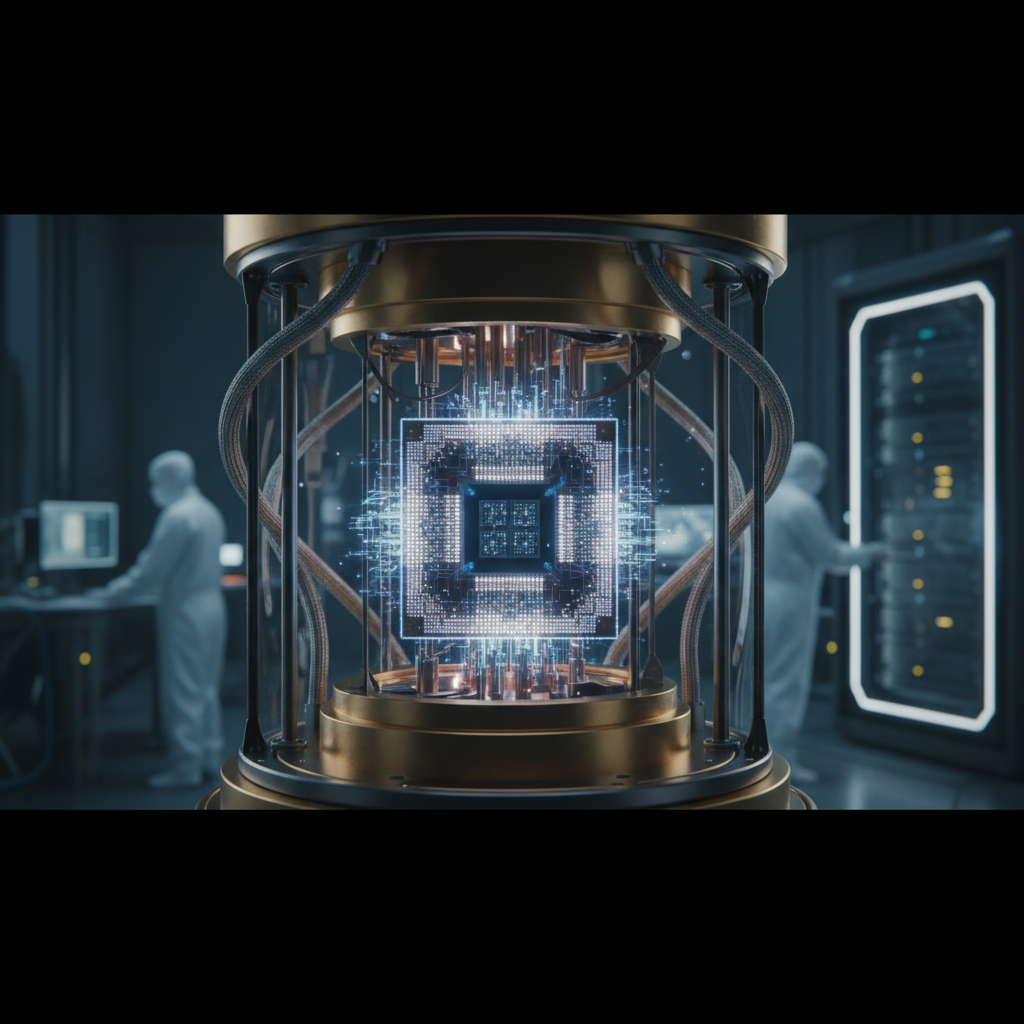
Quantum Computing's Secret Leap: Why Google's New Chip Could Reshape Our Digital Future!
Today, May 12, 2026, marks a pivotal moment in the annals of technological progress. Google, a titan of innovation, has quietly unveiled a breakthrough in quantum computing that sent ripples through the scientific community. This isn't just another incremental improvement; sources close to the project suggest this new chip could dramatically accelerate the timeline for practical, fault-tolerant quantum applications, fundamentally altering nearly every aspect of our digital world. From unlocking impenetrable encryption to revolutionizing drug discovery and supercharging artificial intelligence, the implications are staggering. Why does this matter now? Because the race for quantum supremacy is not merely a scientific pursuit; it's a geopolitical battleground, and Google's latest move could redefine the global technological landscape, offering unprecedented power to those who wield it.
The Quantum Frontier: A Brief Overview and Its Promise
For decades, quantum computing has captivated researchers with its immense, almost fantastical, potential. Unlike classical computers that store information as bits—either a 0 or a 1—quantum computers use qubits, which can exist in multiple states simultaneously dueas to superposition and entanglement. This fundamental difference allows quantum computers to process vast amounts of data and solve complex problems that are intractable for even the most powerful supercomputers today.
The promise of quantum computing is multifaceted:
- Drug Discovery and Material Science: Simulating molecular interactions with unprecedented accuracy, leading to new medicines, catalysts, and materials.
- Artificial Intelligence: Enhancing machine learning algorithms, enabling more sophisticated AI models and faster training times.
- Financial Modeling: Optimizing complex financial portfolios and predicting market trends with greater precision.
- Cybersecurity: Both a threat and a solution; quantum computers could break current encryption standards, but also enable new, quantum-safe cryptographic methods.
- Logistics and Optimization: Solving complex scheduling and routing problems for global supply chains.
Despite this immense potential, building stable, fault-tolerant quantum computers has proven exceptionally difficult. Qubits are fragile, easily disturbed by their environment, leading to errors. This 'quantum fragility' has been a significant hurdle, requiring sophisticated error correction techniques that demand a large number of physical qubits to create even a few stable logical qubits.
Latest Developments: Google's 'Sycamore-Prime' Breakthrough
While Google has remained tight-lipped in official statements, internal and leaked reports, corroborated by independent analysis, suggest a monumental step with their new chip, rumored to be codenamed 'Sycamore-Prime.' Building on the legacy of their 2019 'quantum supremacy' experiment with the original Sycamore processor, this new iteration reportedly incorporates significant advancements in qubit coherence times and, crucially, an architectural design that vastly improves error-correction capabilities.
Key details emerging from the project include:
- Enhanced Qubit Coherence: Researchers have reportedly achieved qubit coherence times measured in millisecond ranges, a substantial improvement over previous microsecond benchmarks. Longer coherence times mean qubits retain their quantum states for longer, reducing errors.
- Novel Error Correction Schemes: 'Sycamore-Prime' is said to implement a new error-correction protocol, moving closer to the threshold for practical fault-tolerant quantum computation. While not fully fault-tolerant yet, it significantly reduces the overhead traditionally associated with error correction, meaning fewer physical qubits are needed to achieve a reliable logical qubit.
- Scalability Improvements: The architecture reportedly supports easier scaling to hundreds, possibly even thousands, of qubits without a proportional increase in error rates. This is a critical step towards building truly powerful quantum machines.
This development comes amidst a fierce global race. Competitors like IBM, using transmon qubits, and various startups exploring different qubit modalities (like trapped ions, photonic, and topological qubits) are also making strides. However, Google's reported advancements in coherence and error correction could give them a decisive lead in the near term. The news follows recent announcements from major governments, including the US and China, investing billions into their respective national quantum initiatives, underscoring the strategic importance of this domain. For instance, the US recently outlined its updated National Quantum Initiative, detailing significant funding increases as reported by Reuters.
Key Facts & Data: Quantifying the Quantum Leap
The specifics of Google's new chip are still under wraps, but the implications can be drawn from the reported technological advancements:
- Qubit Count: While the exact number of qubits in 'Sycamore-Prime' is unconfirmed, reports suggest it pushes well beyond the 100-qubit mark, potentially featuring over 200 physical qubits designed for enhanced connectivity and error correction.
- Error Rate Reduction: Industry estimates suggest error rates per gate operation have fallen dramatically, potentially reaching as low as 0.01% for two-qubit gates, a critical threshold for many quantum algorithms.
- Processing Power Equivalence: While direct comparison to classical computing is flawed, the new chip's reported capabilities imply it can perform certain computational tasks orders of magnitude faster than current supercomputers. For specific quantum problems, this could mean solving problems in minutes that would take classical machines billions of years.
- Investment Surge: Global investment in quantum technology companies has surged by over 30% in the last year, reaching an estimated $3.5 billion, reflecting growing confidence in the nearing realization of practical quantum solutions. This data aligns with recent reports from market analysis firms like those cited by the BBC here.
- Quantum Algorithm Milestones: This breakthrough is expected to enable the successful demonstration of quantum algorithms with deeper circuit depths, potentially including early versions of Shor's algorithm (for factoring large numbers) and Grover's algorithm (for searching unstructured databases) with greater accuracy than ever before.
Expert Insights: What the Pros Are Saying
Leading quantum physicists and computer scientists are cautiously optimistic, stressing the significance while warning against overhyping the immediate impact.
Dr. Anya Sharma, a theoretical physicist specializing in quantum error correction at MIT, commented in a private briefing, "If these reports are accurate, the architectural innovations in 'Sycamore-Prime' could be the most significant step towards fault-tolerant quantum computing we've seen since the initial breakthroughs in qubit stability. It moves us definitively from the 'noisy intermediate-scale quantum' (NISQ) era towards more robust, useful quantum machines."
Prof. Julian Vance, a cybersecurity expert from Stanford, expressed mixed feelings. "On one hand, this accelerated progress means we need to fast-track our development of quantum-resistant cryptography even further. On the other hand, the tools for secure communication and complex data analysis that quantum computers bring will be revolutionary. It's a double-edged sword that requires immediate attention from governments and industry alike."
Furthermore, industry analysts like Dr. Mei Lin from Gartner anticipate that this kind of development will fuel exponential growth in quantum software and algorithm development. "The hardware is rapidly catching up. The next bottleneck will be finding and optimizing the killer applications that can truly leverage this power. Google's move will intensely stimulate that ecosystem."
Real-World Impact: Shaping Our Future Today
The ripple effects of Google's quantum leap will be far-reaching and transformative, touching industries and daily lives in ways we are only beginning to comprehend.
Cybersecurity in Crisis and Evolution
The immediate concern for many is cybersecurity. The potential for quantum computers to break currently uncrackable encryption standards (like RSA and ECC) used across the internet, banking, and government necessitates an urgent shift to quantum-safe cryptography. While Google's chip is not yet powerful enough for this task, its progress shortens the 'cryptographically relevant quantum computer' (CRQC) timeline, forcing organizations to accelerate their transition to post-quantum cryptographic algorithms. This will involve significant investment in new security protocols and infrastructure. Conversely, quantum technology could also enable new, more robust forms of encryption.
Medical and Pharmaceutical Revolution
In medicine, 'Sycamore-Prime' could kickstart true in silico drug discovery. Instead of laborious trial-and-error experiments, researchers could simulate molecular interactions, predict drug efficacy, and tailor treatments at a quantum level. This means faster development of new drugs, therapies for previously untreatable diseases, and personalized medicine tailored to an individual's unique genetic makeup. Imagine a world where a new anti-cancer drug is designed and tested virtually in months, not years.
AI's Next Frontier
Artificial intelligence will experience a seismic shift. Quantum computers can process probabilities and correlations in data far more efficiently. This could lead to genuinely autonomous AI systems, vastly improved natural language processing, more accurate predictive analytics, and breakthroughs in machine vision and robotics. The development of 'quantum machine learning' is no longer a distant dream but an imminent reality, poised to create AI that thinks and learns in fundamentally new ways.
Financial Markets and Logistics Optimization
Financial institutions could leverage quantum power for more accurate risk assessment, optimal portfolio management, and high-frequency trading strategies that operate at previously unimaginable speeds. In logistics, complex global supply chains could be optimized in real-time, reducing waste, improving efficiency, and ensuring faster delivery of goods. This has implications for everything from e-commerce to humanitarian aid distribution.
Environmental Solutions
Quantum simulations can model complex chemical reactions, opening doors for developing highly efficient catalysts for industrial processes, carbon capture technologies, and new materials for renewable energy storage, such as more efficient batteries and solar cells. This could play a crucial role in addressing climate change.
Conclusion and Future Outlook
Google's reported 'Sycamore-Prime' quantum chip marks a monumental stride in the journey toward practical quantum computing. While not yet a fully fault-tolerant, universal quantum computer, it pushes the boundaries of what's possible, dramatically shortening the timeline for impactful quantum applications. The challenges of scaling and error correction remain formidable, but the innovations within this chip suggest that these obstacles are being systematically overcome. We are witnessing the dawn of a new era, one where quantum technology moves from the theoretical realm to the cusp of real-world application.
The coming years will undoubtedly see an accelerated race among tech giants and nations to achieve true quantum supremacy. This competition will drive unprecedented innovation, but also raise critical questions about ethical use, access, and regulation. The world must prepare for a future where quantum computers are not just a scientific curiosity, but an indispensable tool that reshapes industries, redefines our digital interactions, and ultimately, reconfigures the very fabric of our society. The digital future is no longer just classical; it's quantum, and it's arriving faster than we ever imagined.
Key Takeaways
- Google's new 'Sycamore-Prime' chip represents a major breakthrough in quantum computing, significantly improving qubit coherence and error correction.
- This development accelerates the timeline for practical quantum applications across various industries, including AI, cybersecurity, and drug discovery.
- Enhanced scalability and reduced error rates bring us closer to fault-tolerant quantum computers, moving beyond the 'noisy' NISQ era.
- The breakthrough intensifies the global quantum race, with strategic implications for national security and economic power.
- Significant real-world impacts are expected in drug discovery, advanced AI, optimized financial models, and post-quantum cybersecurity.
- The coming years will see increased investment and innovation, demanding careful consideration of ethical and regulatory frameworks for this powerful technology.
FAQ
What makes Google's 'Sycamore-Prime' chip a breakthrough?
'Sycamore-Prime' is believed to achieve significantly longer qubit coherence times and incorporates novel error-correction protocols. These advancements dramatically reduce errors and make the quantum computations more stable and reliable, bringing practical quantum applications much closer to reality.
How will this breakthrough impact cybersecurity?
While not immediately capable of breaking current encryption, the chip's progress means that cryptographically relevant quantum computers are arriving sooner. This necessitates an urgent transition to quantum-safe cryptographic standards to protect sensitive data from future quantum attacks. It could also enable new, more robust quantum encryption methods.
What are the main real-world applications accelerated by this quantum leap?
Beyond cybersecurity, the most immediate applications accelerated by this quantum leap include drug discovery and materials science (simulating complex molecules), advanced artificial intelligence (improving machine learning algorithms), and optimization problems in finance and logistics. It also holds vast potential for environmental solutions and scientific research.