Global Food Crisis Deepens: Can AI-Powered Agriculture Avert Starvation in 2026?
The Looming Catastrophe: Why the World is Hungrier Than Ever
As of May 15, 2026, the world faces an unprecedented and rapidly escalating global food crisis. Millions are facing acute food insecurity, threatened by starvation on a scale not seen in decades. This isn't merely a localized issue; it's a compounding planetary emergency, fueled by a relentless trifecta of climate change, protracted geopolitical conflicts, and enduring economic instability. The urgency is palpable, and the question on everyone's mind is: how do we feed a planet under siege? While the situation is dire, a nascent, yet promising, beacon of hope emerges through the transformative potential of Artificial Intelligence (AI) in agriculture. This technology, once considered futuristic, is now being rapidly scaled and deployed as a critical intervention, offering a glimmer of possibility amidst widespread despair.
Background: A Decade of Decline Leading to 2026's Dire Straits
The roots of the current crisis extend back years, with contributing factors steadily eroding global food security. Long before 2026, warnings from organizations like the United Nations Food and Agriculture Organization (FAO) highlighted increasing numbers of undernourished people, a trend exacerbated by the COVID-19 pandemic and subsequent economic downturns.
Climate Change: The Relentless Adversary
The most significant driver has been the intensifying impacts of climate change. Extreme weather events, once anomalies, are now commonplace. In 2025 and early 2026, devastating droughts gripped East Africa and parts of South Asia, while unprecedented floods ravaged agricultural heartlands in Southeast Asia and parts of North America. These events have decimated harvests, destroyed infrastructure, and displaced farming communities, leading to massive crop failures and livestock losses.
Geopolitical Conflicts and Supply Chain Disruptions
Concurrent with climate shifts, a series of geopolitical conflicts has further destabilized global food systems. Ongoing regional wars, particularly in Eastern Europe and parts of the Sahel, have disrupted major food-producing regions, blocked critical export routes, and hindered the delivery of humanitarian aid. The resulting spikes in energy prices and fertilizer costs, exacerbated by sanctions and trade restrictions, have made food production prohibitively expensive for many farmers worldwide, reducing yields and further constricting supply chains.
Economic Instability and Poverty
Compounding these factors is persistent global economic instability. High inflation rates, especially in developing nations, coupled with rising unemployment and depreciating national currencies, have dramatically reduced people's purchasing power. Even where food is available, it's increasingly unaffordable for millions of vulnerable households, pushing them deeper into poverty and food insecurity. This confluence of crises has pushed the world to a tipping point, making innovative solutions not just desirable, but absolutely essential.
Latest Developments: The Scramble for Solutions
In response to the deepening crisis, governments, international organizations, and technology firms are aggressively pursuing novel approaches. The spotlight has increasingly turned to AI as a potential game-changer, with pilot programs rapidly expanding.
AI in Precision Agriculture
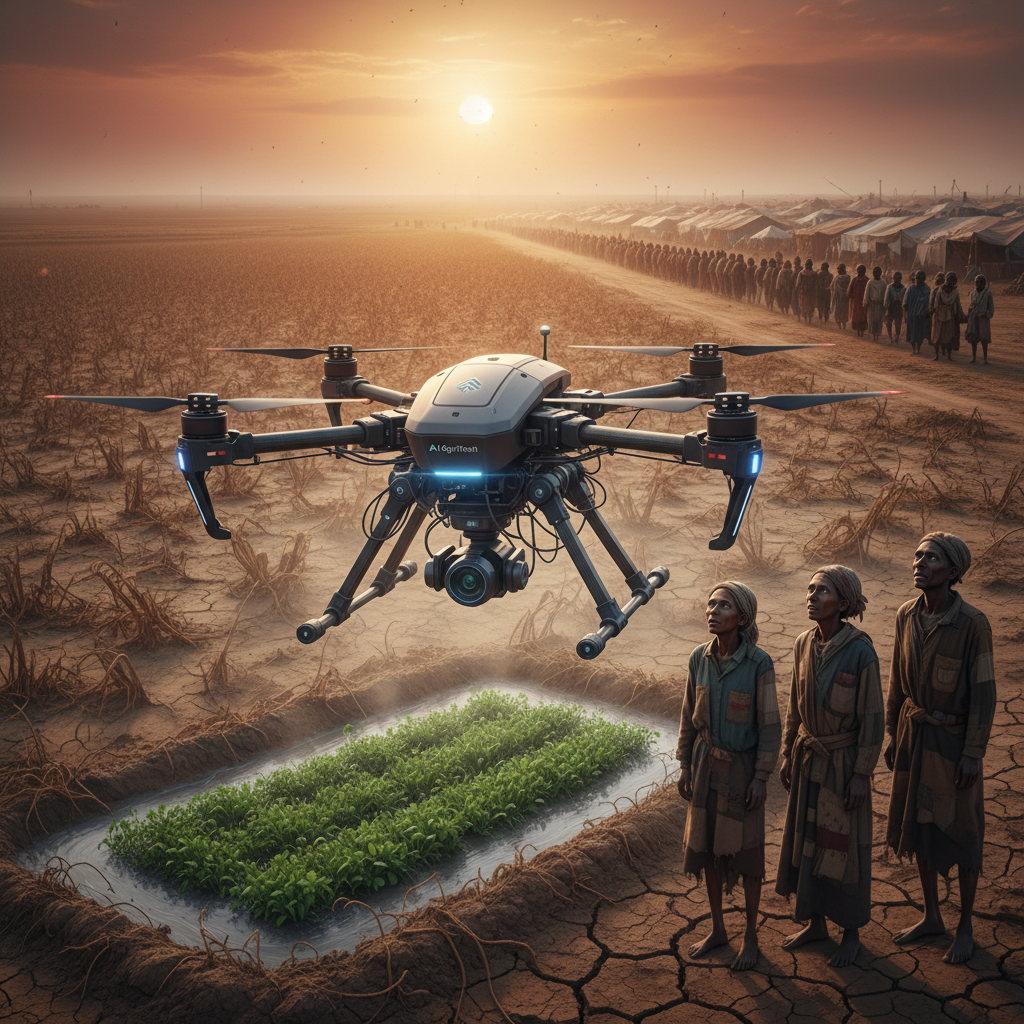
Several nations are investing heavily in AI-driven precision agriculture. Drones equipped with AI cameras are now common in large-scale farming operations, monitoring crop health, detecting pests and diseases early, and optimizing irrigation and nutrient application. In a significant development, a consortium of tech companies and agricultural ministries launched the "Global Agri-Intelligence Network" initiative last month, aiming to collect and analyze granular agricultural data across continents to predict potential famine zones and optimize resource allocation.
Vertical Farms and Controlled Environment Agriculture
The urban landscape is also seeing a transformation. AI-optimized vertical farms, once niche, are being scaled up in major cities worldwide. These facilities use AI to control light, temperature, humidity, and nutrient delivery with unparalleled precision, maximizing yields in minimal space. The latest reports indicate a 300% increase in AI-managed vertical farm capacity in the last 18 months, particularly in regions prone to extreme weather conditions.
Predictive Analytics for Supply Chains
To combat supply chain disruptions, AI-powered predictive analytics platforms are being deployed. These systems analyze real-time data on weather patterns, geopolitical events, market prices, and transportation logistics to anticipate bottlenecks and redirect food supplies more efficiently. The World Food Programme has reportedly integrated several such AI models into its logistics operations to improve humanitarian aid delivery speed and effectiveness.
Ethical AI and Data Privacy Concerns
While promising, the rapid deployment of AI in agriculture is not without its challenges. Concerns around data privacy for farmers, the potential for job displacement in traditional agricultural sectors, and the ethical implications of AI-driven food resource allocation are topics of intense debate and policymaking action at the UN and other international forums.
Key Facts & Data
- Over 800 million people are estimated to be facing chronic undernourishment as of early 2026, an increase of nearly 150 million since 2019. (Source: World Food Programme
- 20 million people are currently in emergency or catastrophe phases of food insecurity across 7 countries. (Source: IPC Global Partners)
- Global food prices have increased by an average of 18% over the past year, with staples like wheat and corn seeing spikes of up to 30% in affected regions.
- Agricultural yield losses due to extreme weather events increased by approximately 25% year-on-year between 2023 and 2025.
- Investment in Agri-AI startups reached nearly $40 billion in 2025, a record high, reflecting intense interest in technological solutions.
- AI-optimized vertical farms are reportedly achieving a 90-95% reduction in water usage compared to traditional field farming for equivalent output.
Expert Insights
"The current food crisis is a stark reminder of our interconnectedness and vulnerability," states Dr. Anya Sharma, lead agricultural economist at the Global Food Security Institute. "While AI offers incredible potential for optimizing production and distribution, it's not a silver bullet. We must concurrently address the root causes: climate change mitigation, conflict resolution, and equitable economic development. Without these, AI can only patch symptoms, not cure the underlying disease."
Professor David Lee, a specialist in AI ethics from Stanford University, adds, "The rapid adoption of AI in agriculture necessitates robust ethical frameworks. We must ensure that these powerful technologies don't exacerbate existing inequalities, disproportionately benefit large corporations, or create new vulnerabilities through over-reliance on complex systems. Transparency, accountability, and inclusive governance are paramount."
Real-World Impact: Lives on the Brink
The human toll of the deepening food crisis is immeasurable. In regions like the Horn of Africa, millions are facing starvation, with children particularly vulnerable to severe malnutrition and associated health complications. Healthcare systems are overwhelmed, and mass displacements are increasing, creating further strain on already fragile humanitarian networks. Families are making impossible choices between food, medication, and education.
In some developed nations, rising food prices are forcing lower-income households to rely more heavily on food banks and charitable organizations, highlighting the crisis's reach beyond traditional 'hunger zones.' The social fabric of communities is being stretched thin, leading to increased instability and potential for unrest.
However, in areas where AI-powered initiatives have been successfully implemented, there are glimmers of hope. Farmers utilizing AI-driven irrigation systems in arid zones report significantly higher yields with less water, improving local food sovereignty. Predictive analytics tools have allowed aid agencies to pre-position supplies before disaster strikes, undoubtedly saving lives. These are incremental victories, but vital ones in a world grappling with such immense challenges.
Conclusion and Future Outlook
The global food crisis of 2026 represents a critical juncture for humanity. While the scale of the challenge is daunting, the rapid integration of AI into agricultural practices offers a vital, though incomplete, pathway forward. The coming years will be defined by how effectively we can harness these technologies while simultaneously addressing the foundational issues of climate change, conflict, and economic disparity.
Future success hinges on international cooperation, ethical deployment of technology, and a renewed commitment to building resilient, sustainable food systems. Without a multi-faceted approach that combines technological innovation with political will and social equity, the specter of widespread starvation will continue to haunt a significant portion of our global population. The path ahead is fraught with challenges, but the potential of AI, when integrated thoughtfully, provides a powerful tool in humanity's fight for food security.
Key Takeaways
- The 2026 global food crisis is severe, driven by climate change, conflicts, and economic instability.
- AI-powered agriculture offers significant promise in precision farming, vertical farms, and supply chain optimization.
- Despite technological advancements, fundamental issues like climate action and conflict resolution remain crucial for long-term food security.
- Ethical concerns regarding data privacy, job displacement, and equitable access to AI technologies must be proactively addressed.
- International collaboration and integrated strategies are essential to leverage AI effectively and prevent widespread starvation.
- Rising food prices and insecurity are impacting both developing and developed nations, increasing strain on global systems.
FAQ
Q: What are the main drivers of the 2026 global food crisis?
A: The crisis is primarily driven by three interconnected factors: accelerating climate change leading to extreme weather events, ongoing geopolitical conflicts disrupting food production and supply chains, and global economic instability reducing purchasing power and increasing poverty.
Q: How is AI currently being used to combat food shortages?
A: AI is being deployed in several critical areas, including precision agriculture (optimizing crop care), AI-controlled vertical farms (maximizing yields in controlled environments), and predictive analytics (improving supply chain efficiency and humanitarian aid delivery).
Q: What are the main challenges in implementing AI solutions for global food security?
A: Key challenges include ensuring equitable access to technology for smallholder farmers, addressing data privacy and security concerns, managing potential job displacement, the high initial investment costs for AI infrastructure, and the ethical implications of AI-driven resource allocation. These technological solutions must also be integrated with broader efforts to address geopolitical and climate issues.